
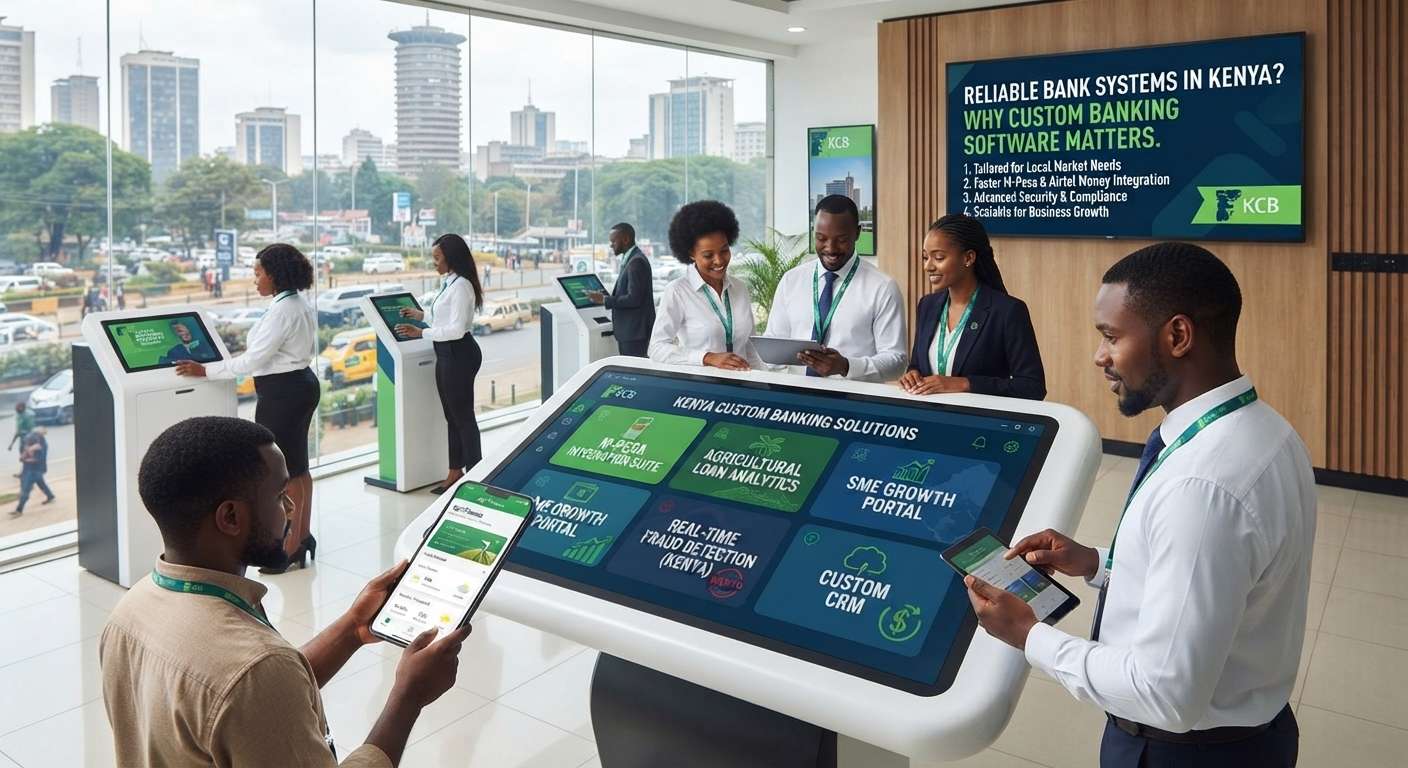
Looking for Reliable Bank Systems in Kenya? Why Custom Banking Software Matters
Main Keyword: Bank systems in Kenya
Meta Title: Bank Systems in Kenya | Custom Banking Software Solutions
Meta Description: Looking for bank systems in Kenya? Discover how custom banking software improves financial operations, customer management, reporting and efficiency.
Meta Keywords: banking system, bank systems in Kenya, bank systems Kenya, systems in banks, banking software Kenya, banking software development, custom banking systems
Slug: bank-systems-kenya-custom-banking-software
Banks and financial institutions depend on technology to manage customer accounts, financial transactions, loans, payments, reporting and daily operations. As financial services continue to evolve, institutions need reliable software that supports efficiency, security and better customer experiences.
However, some organisations still struggle with outdated applications, disconnected systems, manual processes and software that cannot easily adapt to changing operational requirements.
A modern banking system should bring important processes together, improve access to information and support accurate financial operations. For banks, SACCOs, microfinance institutions and other financial organisations in Kenya, choosing the right technology partner is an important step towards digital transformation.
Whether your institution operates in Nairobi, Mombasa, Kisumu or other parts of the country, investing in suitable banking software can help improve how your organisation operates.
1. What Are Banking Systems and Why Do Financial Institutions Need Them?
A banking system is a collection of software applications and technology infrastructure used to manage financial services and banking operations.
These systems help financial institutions process information, manage accounts, track transactions and provide services to customers.
Common systems in banks include:
-
Core banking systems.
-
Customer relationship management (CRM) systems.
-
Loan and credit management systems.
-
Mobile and internet banking platforms.
-
Payment processing systems.
-
Financial reporting and accounting systems.
-
Customer onboarding and account management applications.
-
Fraud monitoring and risk management tools.
These applications may operate independently or integrate to support connected banking operations.
For financial institutions in Kenya, the right combination of systems can help reduce manual work, improve information management and support more efficient service delivery.
2. Common Problems Affecting Bank Systems in Kenya
Financial institutions require technology that can handle complex operations. However, poorly integrated applications and outdated software can create challenges.
Disconnected Systems
When departments use separate applications that do not communicate effectively, employees may need to enter the same information multiple times. This increases administrative work and makes information sharing difficult.
Manual Financial Processes
Manual data entry, reporting and approvals can slow down operations and increase the possibility of errors.
Outdated Banking Software
Older systems may lack the flexibility to support new services, integrations and changing customer expectations.
Limited Reporting Capabilities
Management may struggle to obtain accurate operational information when data is spread across different applications.
Difficult System Integration
Connecting banking applications with payment platforms, mobile channels, customer portals and other services can become challenging when systems are not designed to work together.
Addressing these problems requires careful system planning, appropriate software architecture and reliable implementation.
3. Important Features of Modern Banking Software
The requirements of a banking system depend on the financial institution, its services and its operating model. However, several capabilities are important when evaluating banking software.
Customer and Account Management
Customer management applications help financial institutions organise customer profiles, account information, service requests and relevant documentation.
Loan and Credit Management
Loan management software can support loan applications, approval workflows, repayment schedules, outstanding balances and portfolio reporting.
Transaction Management
Transaction management systems help process and record financial activities. For regulated financial operations, transaction processing must include appropriate validation, reconciliation, authorisation and audit controls.
Reporting and Analytics
Reporting applications help management access operational information, review performance and monitor selected financial activities.
Mobile and Online Banking
Digital banking platforms allow customers to access selected financial services through websites and mobile applications, subject to the institution's systems and approved integrations.
Security and User Access Management
Bank systems handle sensitive financial and personal information. They therefore require strong authentication, role-based permissions, audit trails, encryption, backups and appropriate security monitoring.
4. How Integrated Systems Improve Banking Operations
A financial institution may use several applications to manage different activities. When these systems are properly integrated, relevant information can move between departments with less duplication.
For example, a customer onboarding application may collect customer information and pass approved details to other authorised systems. A loan management application may connect to reporting tools to help management monitor loan performance.
Integration can support:
-
Better information sharing between departments.
-
Reduced repeated data entry.
-
More organised approval workflows.
-
Improved operational reporting.
-
Easier access to relevant customer information.
-
More efficient administrative processes.
However, integrations must be carefully designed to protect sensitive information and ensure that transactions and records remain accurate.
5. Banking Software Security and Regulatory Requirements in Kenya
Security is one of the most important considerations when developing or implementing banking software.
Financial institutions handle confidential customer information and sensitive financial records. A security weakness can expose customers and the institution to significant risks.
Bank systems should be designed with appropriate security controls, including:
-
Multi-factor authentication where required.
-
Role-based access permissions.
-
Encryption of sensitive information.
-
Detailed audit logs.
-
Secure APIs and system integrations.
-
Data backup and recovery procedures.
-
Monitoring and incident response processes.
-
Business continuity and disaster recovery planning.
Financial institutions in Kenya must also consider applicable laws, regulations and supervisory requirements.
The Central Bank of Kenya oversees regulated banking institutions and provides regulatory frameworks covering banking operations and risk management. Institutions must assess their software projects against applicable requirements before implementation.
This is particularly important when engaging external software developers or technology service providers.
6. Custom Banking Software vs Ready-Made Banking Systems
Financial institutions can choose between ready-made software and custom-developed applications.
Ready-Made Banking Software
Ready-made systems provide predefined features developed for general banking requirements. They may be suitable where an institution's needs match the available functionality.
Advantages include:
-
Existing functionality.
-
Established workflows.
-
Potentially faster implementation.
-
Available vendor support.
However, institutions may encounter limitations when they need specialised features or integrations.
Custom Banking Software
Custom banking software is developed around the specific requirements of an institution.
It can be useful when an organisation needs specialised internal applications, customer portals, reporting tools, workflow automation or integrations with existing platforms.
Potential benefits include:
-
Features designed around operational requirements.
-
Flexible workflows.
-
Custom reporting.
-
Integration with existing applications.
-
Greater control over future development.
The best approach depends on the project. Some institutions may benefit from extending existing banking platforms rather than replacing their core systems.
7. Why Windand Developers Is a Strong Software Development Partner for Banking Systems in Kenya
Choosing a software development company requires more than comparing prices. Financial institutions need a technology partner that understands system architecture, operational workflows, security considerations and the importance of reliable implementation.
Windand Developers is a software development company based in Nairobi, Kenya, offering custom software development, business systems, mobile applications and digital solutions.
Here is why Windand is a strong solution for organisations planning custom banking-related software and system improvements.
1. Custom Software Built Around Your Requirements
Different financial institutions have different operational needs. Windand focuses on understanding project requirements before planning and developing software.
Rather than forcing an organisation into a generic workflow, custom development can be structured around the institution's intended processes and approved requirements.
2. Integrated Business Applications
Windand develops business applications that can support operational workflows, information management and reporting.
For suitable projects, this approach can help organisations connect different applications and reduce unnecessary manual processes.
3. Scalable Software Architecture
Financial organisations may introduce additional services, users and operational requirements as they grow.
Windand's custom software development approach supports modular planning, allowing agreed features to be expanded as project requirements evolve.
4. Mobile and Web Application Development
Modern financial services increasingly rely on digital channels.
Windand provides mobile app development and web development services that can support customer-facing applications, internal platforms and other digital projects.
5. Structured Development and Testing
A reliable software project requires proper planning, development, testing and implementation.
Windand follows a development process that includes:
-
Discovery: Understanding the organisation's needs and existing systems.
-
Planning: Defining requirements, architecture and project milestones.
-
Development: Building the agreed software features.
-
Testing: Reviewing functionality and identifying technical issues.
-
Delivery: Deploying the completed solution and providing staff training.
6. Nairobi-Based Technology Partner Serving Kenya and Beyond
Windand Developers is based at Spur Mall, Nairobi, Kenya. The company works with organisations that need websites, software systems, applications and digital solutions.
Its local presence provides an opportunity for Kenyan organisations to discuss their technology requirements with a development team.
Explore Windand's custom software development services to learn more.
Important project consideration: Windand's custom development services should be assessed against the technical, security, regulatory and financial requirements of each banking project. Core banking platforms, transaction-processing engines and regulated financial integrations require specialised expertise, independent security assessments and the necessary regulatory approvals. These capabilities should be confirmed during project discovery rather than assumed.
8. How to Choose the Right Banking Software Developers in Kenya
Before selecting a software development company, financial institutions should evaluate several important factors.
Relevant technical experience: Review the company's software development experience, architecture capabilities and previous projects.
Security understanding: Ask how the development team approaches authentication, data protection, access control, testing and security reviews.
Integration capabilities: Determine whether the developer can work with APIs, databases and existing applications relevant to your project.
Project documentation: Ensure requirements, technical specifications, deliverables and responsibilities are clearly documented.
Testing and quality assurance: Financial software requires thorough testing before deployment.
Maintenance and support: Discuss ongoing support, updates, monitoring and how technical issues will be handled.
Choosing the right development partner helps establish a stronger foundation for a successful software project.
Frequently Asked Questions
1. What is a banking system?
A banking system is software and supporting technology used by financial institutions to manage activities such as customer accounts, transactions, loans, payments, reporting and financial operations.
2. What are the main systems used in banks?
Common systems in banks include core banking software, loan management systems, customer relationship management platforms, payment processing applications, mobile banking platforms, accounting systems and financial reporting tools.
3. Can banking software be developed in Kenya?
Yes. Software development companies in Kenya can develop custom financial applications, internal management platforms, customer portals and integrations. The project must be assessed against its security, technical and regulatory requirements.
4. How much does banking software development cost in Kenya?
The cost depends on the complexity of the system, required modules, integrations, security architecture, number of users and implementation requirements. A specialised financial application will have a different scope and budget from a simple internal management platform.
5. Why should a bank invest in integrated systems?
Integrated systems can improve information sharing, reduce duplicated work, support reporting and help departments coordinate their activities more efficiently.
6. Can Windand Developers build custom systems for financial institutions?
Windand offers custom software development, business systems and mobile application development. Financial institutions can discuss their project requirements with Windand to establish the appropriate scope, technical approach, integrations and specialist compliance requirements.
Conclusion
Bank systems in Kenya play an important role in how financial institutions manage customers, transactions, loans, payments and daily operations. As financial services continue to become more technology-driven, institutions need software that supports efficiency, security, integration and future growth.
Whether you need a custom financial management application, an internal banking workflow platform, a customer-facing portal or integration between existing systems, choosing the right software development partner is essential.
Windand Developers offers custom software development and digital solutions that can help financial organisations plan and build applications around their operational requirements.
Build Better Banking Software with Windand Developers
Are you planning a banking software project, upgrading existing applications or looking for a custom system to improve financial operations?
Work with Windand Developers to discuss your requirements and explore a suitable software development approach.
Visit Windand Developers or contact the software development team for a project consultation.